When Sharks Fly, Does The Audience Follow?
-
AdAge Retail Marketing Report
QSR Ad Insights Report

Concerns about obesity and health are shaping advertising strategies for Quick Services Restaurants – an industry that spends billions on media every year. Learn how the leading players are responding to this new environment in our complimentary QSR Ad Insights Report.
-
When Sharks Fly, Does The Audience Follow?
Insight Center
What creates inspiration? At Kantar Media, we think passionate experts, sound methodology and pertinent analytics help inspire our clients to make creative business decisions everyday. By transforming data into insights, we provide even more opportunities for success.
When Sharks Fly, Does The Audience Follow?When Sharks Fly, Does The Audience Follow?
July 2013
By Jeff Boehme, CRO Kantar Media Audiences, North America
With summer in full swing, TV programmers are once again turning up the heat by offering fresh content to attract viewers – and are casting sharks to take a bite out of the competition.
Since the 1975 premiere of the epic film Jaws, summer has become synonymous with Carcharodon carcharias, the great white shark. The visceral impact of this movie was so significant that many conservation groups still consider the “Jaws Effect” responsible for unrealistic negative stereotypes which reduced shark populations and beach activity. In the late ‘80s, The Discovery Channel introduced Shark Week, a seven-day event intended to promote social awareness and respect for the much-maligned species. Movie and TV producers were quick to recognize a lasting phenomenon and began to manufacture a multitude of shark sequels and various other aquatic monsters (orcas, piranhas, alligators, crocodiles, etc.).
Drawing on this success, cable TV has essentially created a new program genre which stars all forms of these malevolent sea creatures of the deep to prey upon mostly younger victims, a prime advertising demographic. Just when people were feeling safe out of the water, the Syfy Channel debuted their latest summer classic, Sharknado, where man-eating sharks are sucked up in the vortex of tornadoes (actually water spouts) and transported to densely populated Los Angeles.
As silly a concept as flying sharks may be, Sharknado attracted an impressive amount of social media attention. The movie ranked #5 on Twitter for the week and the trailer garnered almost 3 million views on YouTube. The real question for marketers is, did all this buzz increase viewership?
For the premiere telecast, the quick answer is probably not. Despite the social hoopla, Sharknado did not take the audience by storm, ranking only #46 among all primetime programming for the evening based on our return path data audience service. What is interesting, however, is the repeat telecast performed 61% higher than the premiere. Was this due to heavy social media activity coupled with extended press coverage highlighting Sharknado ‘s social media? Probably yes. Based on our analysis of previous Syfy shark-fest movies (Super Shark, Swamp Shark & Sharktopus), all 3 programs’ encore telecasts had lower audiences than their premieres, indicating that all the social media attention did make a difference.
But of course, marketers are most interested in how the commercials performed. Were Sharknado viewers running from advertising during commercial breaks faster than co-star Ian Ziering from the sharks? We analyzed our return path data (RPD) second/second audience patterns to isolate tuning behavior across the entire program as well as during commercials. The below chart illustrates the live+3 second/second household tuning as well as specific commercial pods.
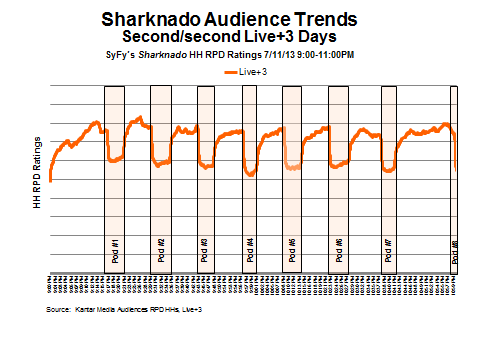
Our analysis highlights several observations. The first is audience consistency. Sharknado experienced no significant audience decline during the length of the program, indicating that viewers were indeed curious enough about how you survive an airborne shark attack to keep watching to the end. However, viewers did consistently tune out during commercials. Based on our Kantar Media metric, commercial tuning index (CTI), which is the precise commercial rating divided by program rating, Sharknado scored a 79.1. This means that about 21% of the commercial content was not seen, and was consistent for each of the commercial pods and on par with all Syfy primetime programming. By comparison the Sharknado encore commercials fared worse, scoring only a 67 CTI – meaning 1/3 of the commercial content was not seen. It therefore seems that the combination of press coverage and social media may attract higher audiences, but they don’t entice audiences to watch commercials.
Most interesting, however, is to understand which consumer segments index well with this audience. When comparing total households to those that have purchased a car, Sharknado did not perform well, indexing at 89. This is not surprising considering the younger profile of the target audience. Note also there were not very many car advertisers in the program, with only 5 of 80 national ads classified as automotive.
There are, however, many advertising categories that did score well perhaps boding well for Sharknado II when they attack Manhattan.
Contact your Kantar Media rep for more information on how we can help your business with advanced audience analytics.
-
Latest Press
Kantar Media Brings More Transparency to the Digital Network & Ad Tech...
U.S. Advertisers & Agencies Benefit from New Technology Research Tool Now Available at...
-
In The News
The analysts at Kantar Media recently pulled together a pile of data on what the last decade of championship football has looked like on America's TVs. - Harvard Business Review
-
Contact Us
Follow us across the Web for a regular stream of insights, news and analysis.
-