 print
print
by Charlie Cook for National Journal, June 4, 2012
Everyone who avidly follows politics
has his or her own list of the true “swing states” in this presidential
election. The lists that really matter, however, are the ones kept by top
strategists for the Obama and Romney campaigns, and the ones kept by the one
large Democratic and five Republican-oriented super PACs and by other major
presidential advertisers this year. Figures compiled by Elizabeth Wilner of
Kantar Media’s Campaign Media Analysis Group show that, beginning on April
10—the day Rick Santorum dropped his presidential bid, effectively making Mitt
Romney the Republican nominee—and through May 29, there have been 63,793
television spots run in 57 out of the nation’s 210 media markets.
CMAG figures look at all broadcast
and cable, national, and local television ads in each of those 210 media
markets. They are analyzed by CMAG’s staff and divided by the number of
Electoral College votes that each state has. Nevada ranked first with $677,332
per Electoral College vote. Iowa came in second with $496,088, and Ohio was
third with $467,068. In fourth place was Virginia with $331,680, followed by
Colorado with $313,653. New Hampshire came in sixth with $283,342, and North
Carolina came in seventh with $237,329. In eighth and ninth places,
respectively, were Pennsylvania at $204,670 and Florida at $101,107. These data
potentially call into question the Romney campaign’s seriousness about
contesting Pennsylvania and about how long Democrats plan to compete for
Florida.
According to Wilner, $8,407,220 was
the total aired from April 10 to May 29 in Ohio alone—tops on the national list
in total general-election television spending so far. Virginia was in second
place with $4,311,840; Pennsylvania came in third with $4,093,400; and Nevada
fell into fourth place with $4,063,990. Ranking fifth, sixth, and seventh were
North Carolina with $3,559,940; Iowa with $2,976,530 (including spending in
neighboring Omaha); and Florida with $2,932,110. Colorado came next with
$2,822,880, followed by New Hampshire with $1,133,370.
Conspicuous in its absence on the
list is Wisconsin. As with so much of life, all is not always as it seems.
Neither side spent any money in the Badger State, expected by many observers to
be a swing state. The truth is, both sides’ presidential strategists wanted to
stay off the air until after Tuesday’s recall election of Gov. Scott Walker. In
a couple of weeks, we will be able to see where Wisconsin falls on the priority
list. CMAG chief Ken Goldstein points out that between the presidential
primary, the recall election, a contested GOP Senate primary contest, and
reasonably competitive Senate and presidential races in the state, Wisconsin
television viewers will be enduring more political ads than any state in
history.
Nationally, with all of this money
being spent on general-election television, even before the last primaries have
been officially conducted, total presidential spending is likely to easily blow
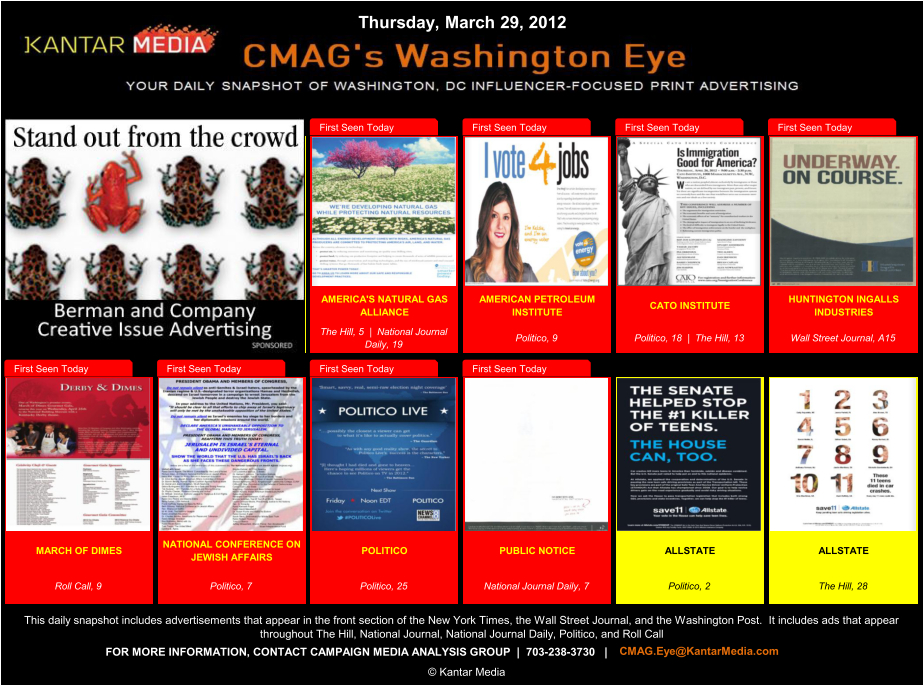
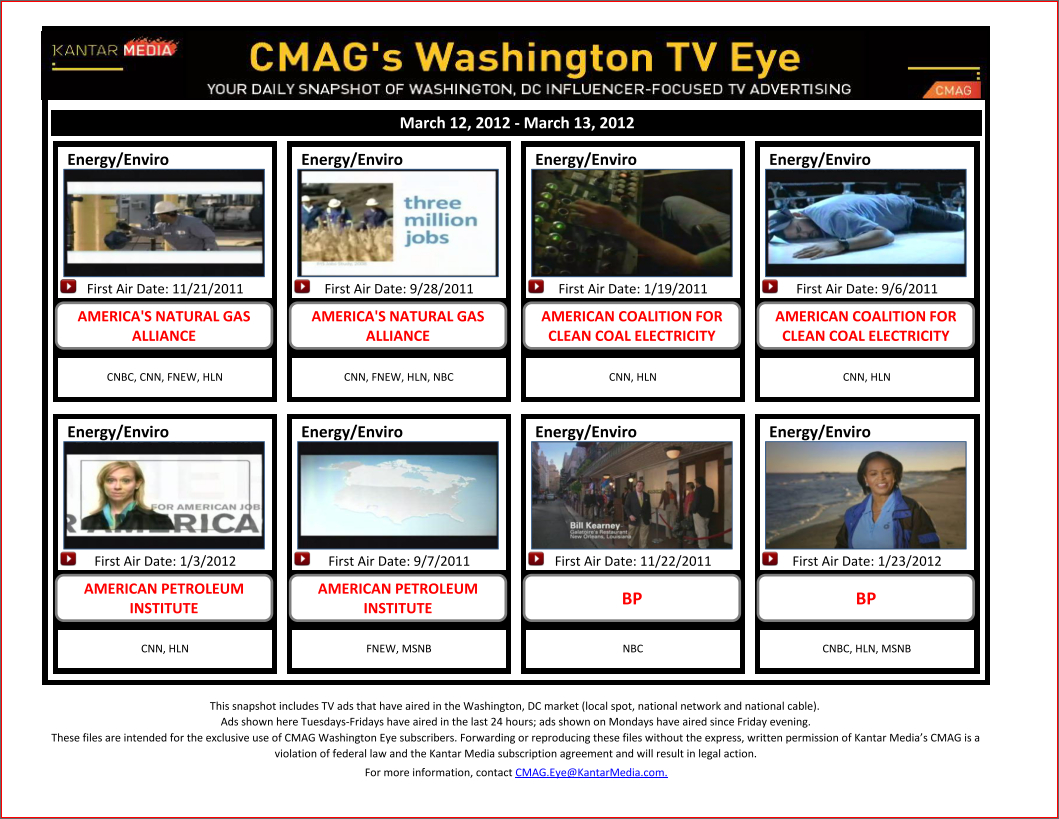
past $2 billion. It’s little wonder, then, that Kantar’s CMAG has carved out a
vital niche in the process. CMAG tells highly interested and deeply invested
parties who is spending what, how much they are spending, and where they are
spending it.
But CMAG provides this information
with the “secret sauce” added. It tells clients the tone and content of the ads
and when a campaign is changing its message and shifting its resources on a
day-to-day and week-to-week basis. It’s not hard to imagine how this info is used:
Knowing that the opposition or competing interest group has shifted its
advertising focus or has changed the tone and content of an ad can lead to the
other side making a countermove. Thus the data turn these campaigns into
fast-moving chess games based almost on real-time updates of the ad mix.
As soon as the November election is
over, CMAG’s Goldstein and Wilner expect a deluge of advertising in the
Washington, D.C., market as well as in others. Interest groups will battle to
get messages across in anticipation of the lame-duck session of Congress. The
number of different organizations expected to go on the air trying to protect
various provisions and program funding may make the health care reform fight
look like small potatoes by comparison. For broadcasters and certain
publications, we’ll just call that the dessert after the Thanksgiving dinner.
Original source: http://www.nationaljournal.com/columns/off-to-the-races/following-the-money-20120604?print=true