

 print
print New York, NY, March 6, 2013 – Anticipation is building for the annual NCAA Division 1 Men’s Basketball Championship, better known as “March Madness,” which tips off on March 19th. For basketball fans, that anticipation centers around their bracket entry in a betting pool and the fortunes of their alma mater on the basketball court. For businesses, it’s the anticipation of reduced productivity as employees take out time during their work day to follow the tournament. And for a select group of advertisers, it’s the anticipation of how sizable marketing investments in the tournament will perform.
“March Madness is an exceptional event with high engagement, rooted in the millions of people filling out tournament brackets and the broad-based enthusiasm that comes from having 68 teams competing for a championship,” said Jon Swallen, Chief Research Officer of Kantar Media. “Marketers use a wide variety of tactics to leverage interest in the tournament including traditional TV ads; print and digital elements; promotions around the brackets; prize trips to the finals; and on-site marketing.”
An analysis of trend data by Kantar Media shows how the tournament has evolved over the past decade to become one of the largest and most valuable properties in all of television sports.
TV Ad Revenue
Over the past 10 years (2003-2012), the NCAA men’s basketball tournament has generated more than $5.9 billion of national TV ad spending from 266 different marketers. Ad revenue in 2012 surpassed the $1 billion mark for the first time.
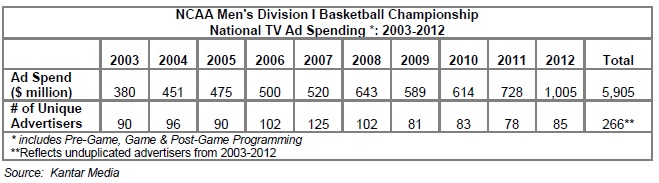
Since 2011, every tournament game has been aired nationally, producing more advertising inventory for sale – and sharply higher revenue - as compared to earlier years. Over the past two years the rate of ad spending has increased by a staggering 64 percent.
Now the Top Franchise in Post-Season TV Sports
In 2012 the NCAA men’s basketball tournament displaced pro football as the most lucrative post-season sports franchise as measured by national TV ad revenue. With just over $1 billion of ad spending, the tournament also exceeded the combined post-season total for Major League Baseball, the National Basketball Association, and the National Hockey League.

Price of Advertising Grows
The price of a TV commercial rises during the tournament and peaks with the championship game. The average cost to an individual advertiser is principally affected by how deep into the event their package extends and their mix of air time between the less expensive early rounds and the pricier later rounds.
In 2012, the average price of a :30 unit in the championship game was $1.34 million, up 8.0 percent from the prior year.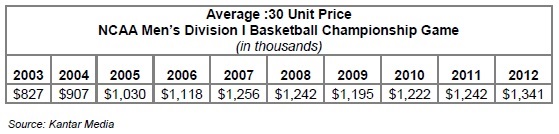
To put this pricing in context, it’s slightly lower than the AFC/NFC pro football championship games that determine the Super Bowl contestants, but much more expensive than the top-priced air time in NBA and MLB programming.

An Expanding Digital Presence
As in prior years, multi-screen digital access to the 2013 tournament will be available to fans via PC, smartphone and tablet devices. All games will be streamed live and the ad-sponsored videocasts offer another platform for marketers to deliver commercial messages. Streamed viewing tends to be highest in the first week of the event, driven by the combination of at-work viewership and multiple games being played simultaneously.
In addition to game coverage, the digital offering also includes a sponsored bracket game as well as a sponsored “Social Arena” where people can follow game tweets and participate in fan chats.
Top Advertisers
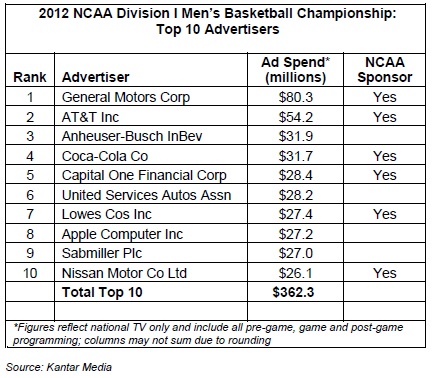
In recent years, a range of 80-85 different companies have bought TV air time during each annual tournament. A small number of advertisers hold dominant positions, and the top ten consistently account for more than one-third of the total TV ad spending each year.
Many of the marketers in this upper echelon have separate corporate sponsorship deals with the NCAA, which give them additional opportunities to build marketing programs around collegiate athletics.
In 2012, the top ten advertisers invested a total of $362.3 million to pitch their messages at NCAA viewers.
 Leading Categories
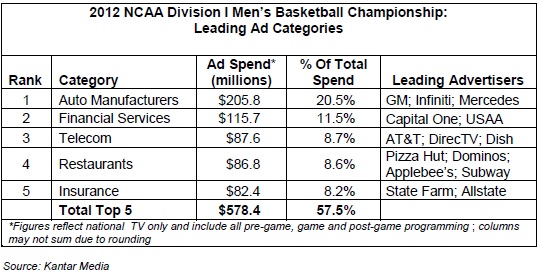
The leading ad categories in the tournament mirrors the ad roster found in other major live sporting events. In 2012, the top five categories spent $578.4 million and accounted for 57.5 percent of the total TV ad expenditures. Two of these categories (Insurance and Restaurants) did not have a single marketer in the top ten list of advertisers, an indication that category money came from a deeper list of competing brands.
 Keeping TV Viewers Interested
From opening night to the championship contest, the basketball tournament runs for 21 days and presents an opportunity for marketers to engage viewers over an extended period. The dark lining to that silver cloud is the potential for an advertiser to wear out its welcome and alienate the audience through sheer volume and repetition of its ad messages. The risk is greatest for the sponsors with ad packages that extend all the way through to the final game because they are airing the most spots - and also spending the most money.
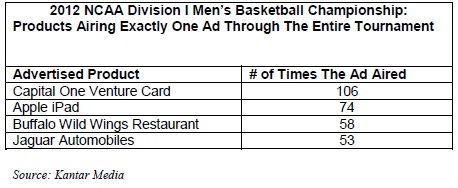
A common strategy to try and forestall message fatigue is to have multiple commercials and rotate the airplay of these executions. Most of the products that advertise throughout the entire tournament use this ploy, but each year a handful instead repetitively pound away with just a solitary commercial, potentially a turn-off for consumers.
About Kantar Media
Kantar Media provides strategic advice and competitive intelligence to the world’s leading brands, publishers, agencies and industry bodies, helping them navigate and succeed in a rapidly evolving media industry. This includes analysis of paid media opportunities; counsel on brand reputation, corporate management and consumer engagement through owned media; and, evaluating consumers’ reactions in earned media. Kantar Media provides clients with a broad range of insights from audience research, competitive intelligence, vital consumer behavior and digital insights, to marketing effectiveness and online influence. Our experts currently work with 22,000 companies tracking 3 million brands in 50 countries. www.KantarMediaNA.com