

 print
print Historical Advertising Data Showcases Super Bowl’s Biggest Spenders, Rising Ad Rates, Competitive Clutter and First-Time Advertisers
New York, NY, January 14, 2013 – Among football fans, the interest surrounding Super Bowl XLVII on February 3 is centered on which team will triumph on the playing field. But for the advertising industry, interest is instead focused on the TV commercials that will appear during the game and which marketers will score or fumble on advertising’s biggest stage.
Kantar Media has mined its extensive database to report on the past ten years of Super Bowl advertising. From 2003 through 2012, the Super Bowl game has generated $1.85 billion of network advertising sales from more than 130 marketers.
Top Five Super Bowl Advertisers
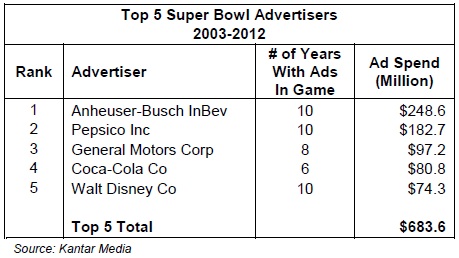
The top five Super Bowl advertisers over the past ten years have spent $683.6 million on advertising during the game, accounting for 37 percent of total advertising revenue. Anheuser-Busch InBev and Pepsico lead the pack, followed by General Motors, Coca-Cola and Walt Disney.
The Price of Advertising
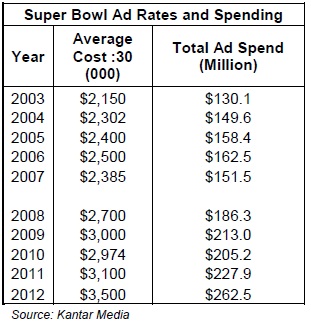
The average rate for a 30-second advertisement in the Super Bowl has increased by more than 60 percent during the past decade, reaching $3.5 million last year. Healthy demand is expected to result in higher pricing for the 2013 game, with CBS claiming an average price of around $3.8 million for a 30-second unit.
The actual amount paid by individual marketers will vary depending on where the ad runs in the game, how much commercial time is purchased and whether the advertiser opts for a larger package that includes spots in the pre-game and/or post-game coverage.
The Holding Power of Super Bowl Ads
In exchange for the hefty price of air time, advertisers get an audience that stays around during the commercial breaks. In the 2012 game the audience tuneaway rate during the average commercial was only 0.7 percent, or seven out of every 1,000 viewers. A normal rate for TV programming is about five times higher at 3 to 4 percent.
Over the course of the more than three-hour football game, there are natural fluctuations in audience size. From trough to peak it’s not unusual to have a swing exceeding 10 percent, even in a competitive and entertaining contest. However, the retention of ads as measured by the proportion of viewers who tune away is very consistent throughout the broadcast. It’s proof that people are interested in seeing Super Bowl commercials.
More Advertising, More Clutter
Over the past ten years, the volume of commercial time in the game has been edging upwards even as the price of advertising has become more expensive. The past three Super Bowls have been the most ad-saturated in history, each containing more than 47 minutes of commercial time. This includes paying sponsors, commercial messages from the NFL, and “house ads” that the network airing the game uses to promote its own shows.
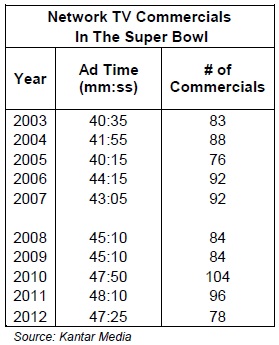
Even as the amount of ad time has been rising, the number of commercial messages has been shrinking because more advertisers have been purchasing longer length spots.
Longer Length Commercials
Despite the high cost of air time in the Super Bowl, a significant proportion of advertisers opt to spend even more by running longer length commercials. It’s an effort to further engage viewers by telling a story instead of just pitching a message. Nearly one-fifth of the spots in the 2012 game were 60 seconds or longer, an all-time record.
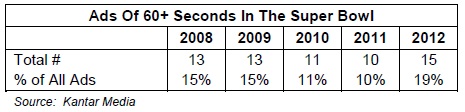
By comparison, the normal proportion of long-form ads on broadcast networks is about six percent.
First Time Advertisers
In recent years, there has been a steady influx of first-time advertisers eager for the recognition and brand-building opportunity of the Super Bowl spotlight. In 2012 first-time advertisers accounted for 30 percent of the Super Bowl ad lineup.
A sizable rookie class is also expected in 2013. Marketers that have publicly confirmed their first-time participation to date include Gildan Activewear, Oreo Cookies, Paramount Farms and Soda Stream International.
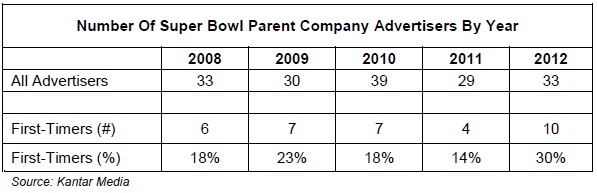
Small Players on a Big Stage
The flow of first-time advertisers has produced a parallel trend: a parade of small marketers who invest a hefty chunk of their annual budget in the Super Bowl. In 2011, five Super Bowl advertisers put more than 10 percent of their full-year media budgets into the game.
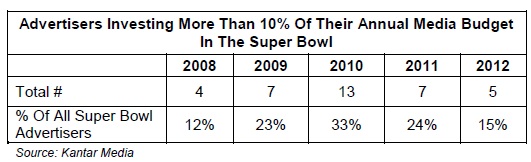
The most leveraged sponsors in the 2012 Super Bowl were Careerbuilder and Teleflora, each of whom invested more than 30 percent of their full-year ad budget to appear in the game.
Top Super Bowl Advertising Categories
Over the past decade, the Super Bowl has attracted a bevy of different automotive, movie studio and dot-com companies, making these the most populous and competitive ad categories.
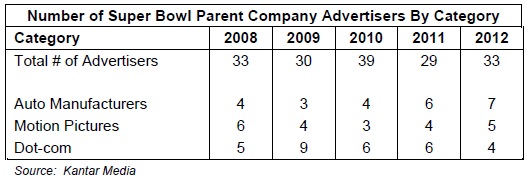
Competitive message clutter within the motion picture sector is more severe than the table implies because studios habitually use their inventory to promote multiple films. Last year, there were ads for seven different films.
Gridlock: Another Auto Traffic Jam
The 2012 Super Bowl smashed all records for auto manufacturer advertising with a staggering $94.5 million spent on 16 messages for 12 different brands. The 2013 game will have another glut of car ads. Based on corporate announcements thus far, at least nine different auto nameplates (Audi, Chrysler, Fiat, Hyundai, Kia, Lincoln, Mercedes, Toyota and Volkswagen) will go head-to-head.
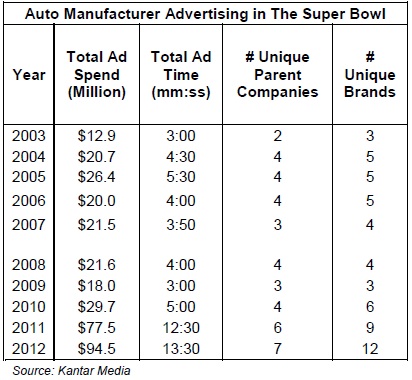
With so many competing messages, it will be that much harder for any individual automaker to stand out from the pack.
How Large Is The Super Bowl Versus Other Sport Franchises?
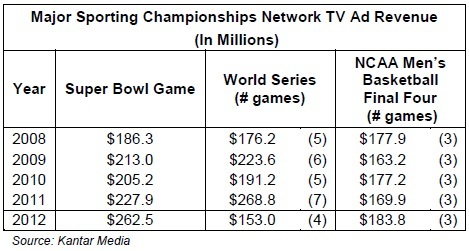
Major League Baseball’s World Series and the NCAA Men’s Basketball Championship are two other high profile sporting events that attract significant interest from TV advertisers. But how do these compare to the Super Bowl in terms of ad spend?
The World Series is comprised of four to seven games. March Madness peaks with the semi-finals and championship on its final weekend, a total of three games. The Super Bowl, of course, is a single telecast. In recent years, it has been pulling away from March Madness and exceeds the World Series in years when the Fall Classic lasts five games or fewer.
About Kantar Media
Kantar Media provides strategic advice and competitive intelligence to the world’s leading brands, publishers, agencies and industry bodies, helping them navigate and succeed in a rapidly evolving media industry. This includes analysis of paid media opportunities; counsel on brand reputation, corporate management and consumer engagement through owned media; and, evaluating consumers’ reactions in earned media. Kantar Media provides clients with a broad range of insights from audience research, competitive intelligence, vital consumer behavior and digital insights, to marketing effectiveness and online influence. Our experts currently work with 22,000 companies tracking 3 million brands in 50 countries. www.KantarMediaNA.com